How Automated Lighting Can Support Wellbeing at Home
A practical guide to using Lutron lighting scenes, schedules, shading and straightforward wall controls to make everyday routines more comfortable.
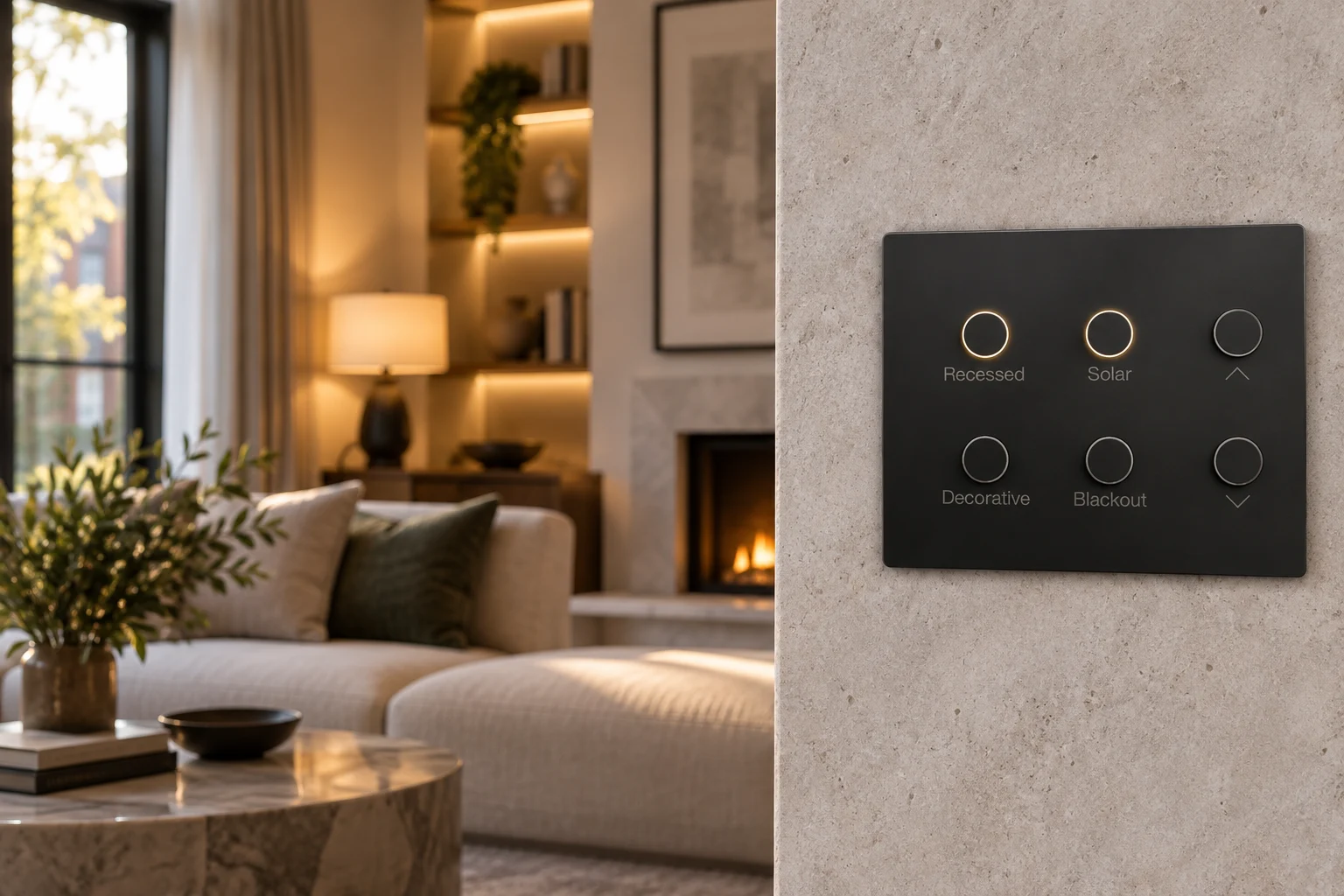
An engraved Lutron scene control keeps everyday lighting settings available at the wall.
Written by ConnorPublished 1 August 2024Updated 28 September 2026 · London Electricals editorial update
Automated lighting can bring useful light to the morning routine, clear task light during the day and a softer room in the evening. We design those settings around the way you live, with straightforward wall controls for family and guests.
The important distinction is between adding remote control and designing the light properly. An app alone does not improve a room. The result comes from the fittings, circuits, colour quality, glare control, daylight, shading, scene programming and the position of the controls working together.
What automated lighting brings to daily life
Automation removes repeated small decisions. Instead of adjusting five circuits separately, one clearly named scene can recall the agreed balance. A well-planned system can also coordinate lighting with motorised shades and timed events, while retaining simple local control.
Comfort: reduce harsh contrasts by balancing task, ambient and decorative light.
Convenience: use one scene for an activity instead of operating several dimmers individually.
Orientation: provide suitable low-level route lighting where it is needed after dark.
Consistency: recall tested settings for reading, cooking, entertaining or watching a film.
Daylight use: coordinate shades and electric light so that useful daylight is not ignored.
The system still needs an obvious off command, sensible manual control and a clear response when something is not operating normally. Good automation should reduce friction, not make the homeowner dependent on a phone.
Light timing, comfort and the body clock
Light is one of the signals that helps the body distinguish day from night. The International Commission on Illumination recommends a pattern of stronger light exposure during the day, much lower exposure during the hours before bed and very little light during sleep. It also stresses that good lighting must balance wellbeing, visual needs, glare, energy use and the architecture of the space. See the CIE position statement on integrative lighting.
For the home, we focus on comfortable daytime and evening settings, considering timing, brightness, colour and daylight together. Those choices are reviewed in the actual rooms as part of commissioning.
Part of the day
Useful design approach
What to check
Morning
Open agreed shades and bring up useful light gradually in occupied rooms.
The room becomes practical without shining a bright source directly towards the bed or seating position.
Daytime
Use daylight first, then add task and ambient light where the activity requires it.
Worktops, desks and reading positions have enough light without troublesome reflections.
Evening
Use lower scene levels and fewer bright sources where practical.
People can still move, read and socialise comfortably; decorative effects do not replace necessary task light.
Night
Provide restrained route lighting only where it is genuinely required.
Controls are easy to find and the scene does not accidentally switch on bright adjoining areas.
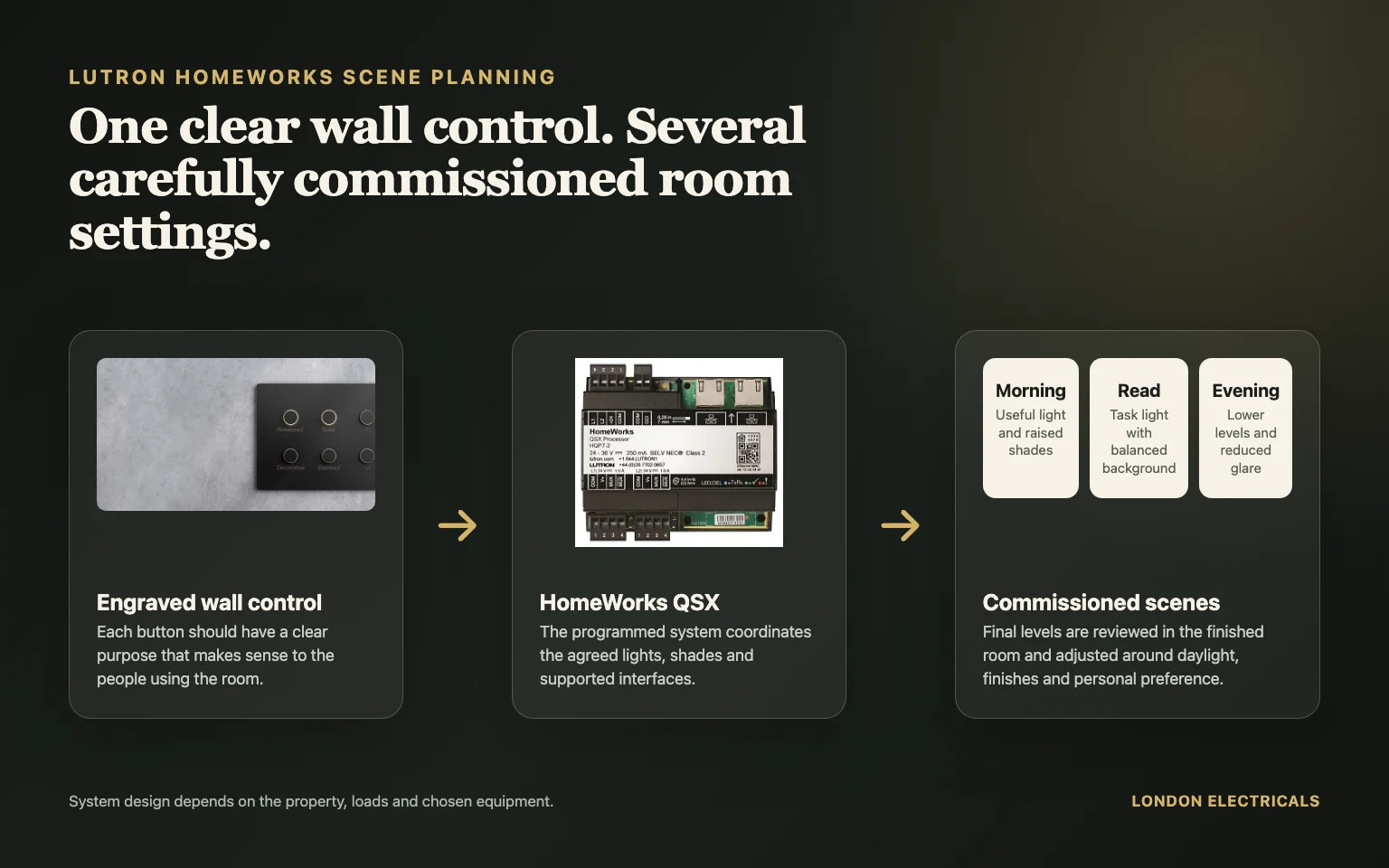
Lutron HomeWorks scene planning links a clearly engraved wall control to programmed lighting and shading settings that are checked in the finished room.
What a Lutron HomeWorks system adds
For a whole-home project, Lutron HomeWorks can coordinate lighting circuits, compatible shades and supported third-party interfaces through programmed scenes. The value is not the number of functions available; it is choosing the few functions that make each room easier to use.
The wall control matters. Lutron's wired Alisse specification confirms that its buttons can be programmed for lights, shades, temperature and supported third-party equipment, with engraving and configurable backlighting. The exact design still depends on the chosen HomeWorks equipment and the project specification. See the Lutron HomeWorks wired Alisse specification.
A sitting room might only need four decisions:
Enter: enough light to make the room welcoming and safe to use.
Read: useful light at the preferred chair, balanced with softer background light.
Evening: a lower, warmer-feeling balance for conversation or television.
Off: an unambiguous command for the agreed room circuits.
More buttons are not automatically better. Clear engraving, logical grouping and testing with the homeowner normally matter more than filling every available position.
Room-by-room examples
Kitchen
The kitchen needs clear task lighting for cooking and a softer atmosphere when everyone sits down to eat. We balance pendants, under-cabinet lighting and architectural fittings from the places you actually stand, keeping useful worktop light within easy reach.
Bedroom
A bedroom benefits from clear bedside controls, a useful dressing scene and gentle route lighting. We agree exactly what the goodnight command does, keeping security, emergency and essential exterior circuits on their intended controls.
Living room
Reading, conversation and screen viewing place different demands on the room. The film scene should reduce screen reflections while keeping a suitable route to the door. A reading scene should light the page without creating a bright source in the seated sightline.
Hallways and stairs
Presence detection can make movement through the home feel effortless. We tune the sensor positions, delay and light levels in the room, with clear local controls for family and guests.
Why commissioning matters as much as the equipment
Scene levels selected from a drawing are only a starting point. Paint, stone, timber, artwork, furniture, lamp choice and daylight change how the finished room feels. London Electricals reviews the agreed scenes once the relevant rooms are sufficiently complete, then adjusts them around real sightlines and use.
A proper review should include:
checking every scene from the main seated and standing positions;
confirming compatible LED loads dim smoothly at the required levels;
checking reflections on televisions, glass and polished surfaces;
testing shade movement and safe stopping positions where shading is included;
confirming timeclock events, occupancy behaviour and manual overrides;
reviewing the engraving and explaining the main controls to the homeowner;
recording the final configuration and support route.
This is where a collection of products becomes a system that feels considered. It also gives the homeowner a chance to say that a scene is too bright, too dark or simply unnecessary before the programming is treated as finished.
Can an existing home be upgraded?
Yes. We review the existing wiring, lights and controls, then plan the upgrade around the rooms you want to improve. Wireless, partly wireless and wired HomeWorks designs offer different routes. An Illumination or QS home can be assessed for repair, refreshed scenes or a coordinated upgrade.
For a new build or major refurbishment, early design gives us time to coordinate circuits, keypads, shades and equipment space with the interior. In an occupied home, an engineer visit lets us plan the work around the existing installation.
Frequently asked questions
Does automated lighting improve sleep?
Lighting timing and intensity influence the signals the body receives. We can create brighter daytime settings and softer evenings to complement your routine. Persistent sleep problems are best discussed with a healthcare professional.
Do I need colour-changing or tunable-white fittings?
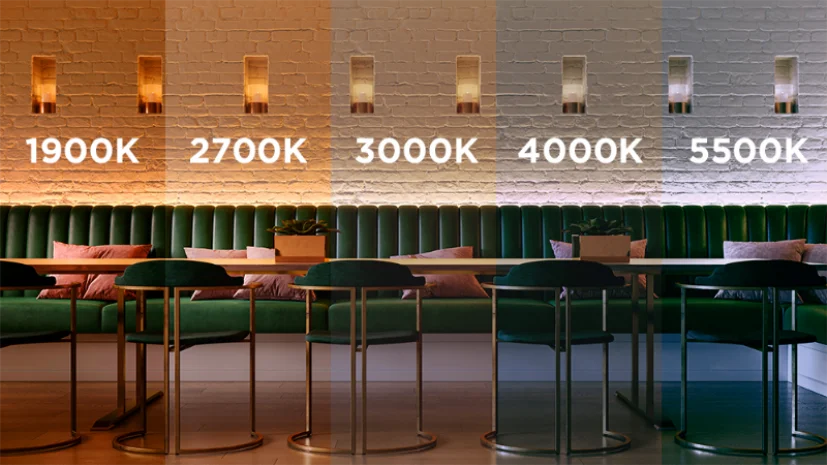
No. Well-chosen fixed-colour fittings, smooth dimming and good daylight control can create a very useful system. Tunable white adds the ability to change the appearance of the light; we specify and commission the equipment together when that suits the brief.
Will the lights still work without the app?
Yes. A professionally designed system includes suitable wall controls for everyday use, with an app for convenient adjustments and remote functions.
How many scenes should a room have?
Only as many as people will understand and use. Three or four well-labelled scenes are often more valuable than a long list of minor variations.