Repair & fault finding
For unresponsive processors, dead keypads, lights stuck on or off, intermittent faults and app or access problems.

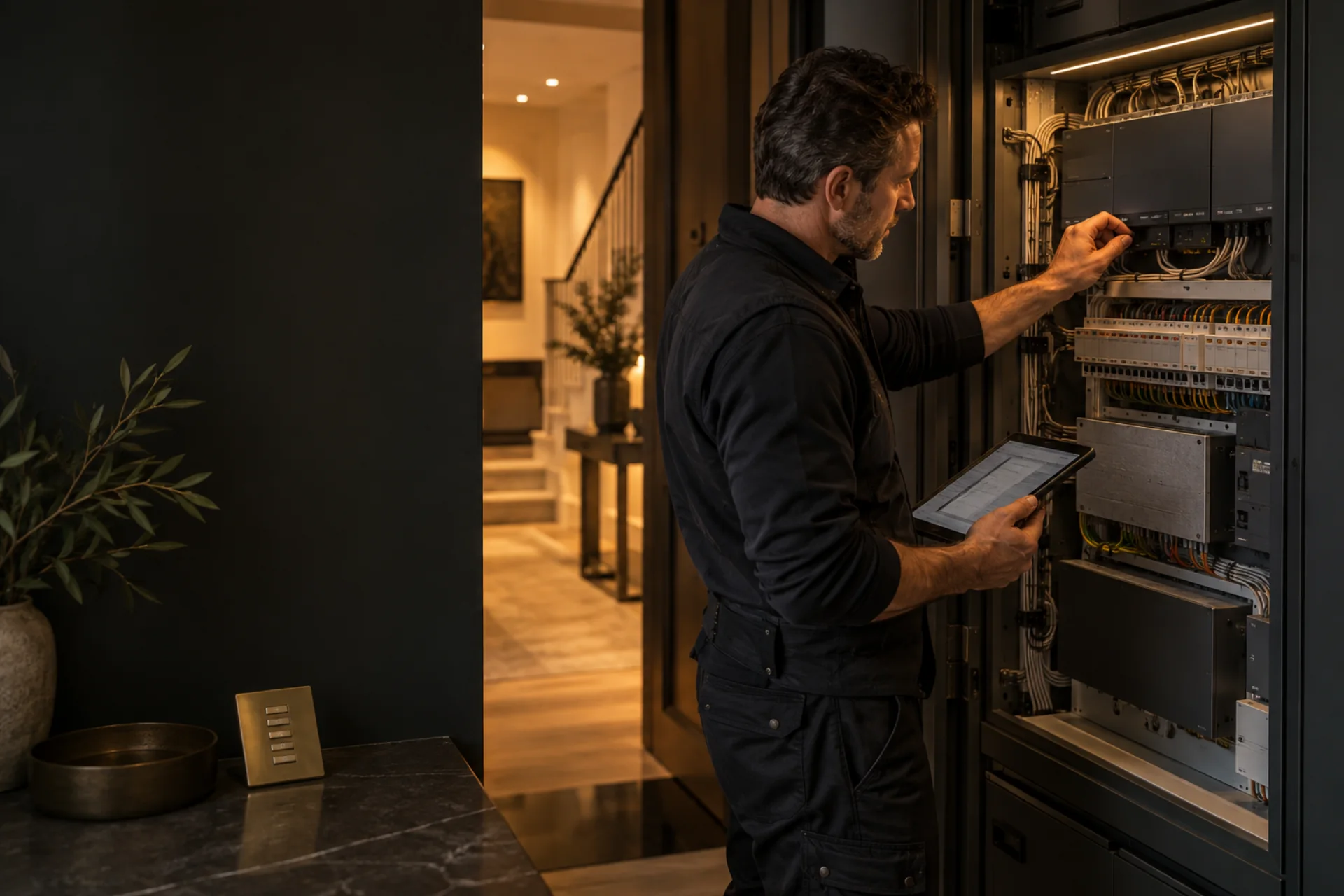
Overview
Identify an existing Lutron system and build a repair or processor-upgrade brief, or plan a new HomeWorks QSX system room by room.
Start with the system already in your home, or build a new HomeWorks QSX plan room by room. You can begin without knowing the processor model or every technical detail.
Start with the system you have
You do not need model numbers or a programming file to begin. Choose the closest starting point and we will turn what you know into a useful brief.
Lutron repair & upgrade assessment
Tell us what the system is doing now—even if all you know is that the lights, keypads or app have stopped behaving properly. We will organise the evidence and identify the right first review.
Your likely first review
This online result organises your symptoms; it is not an electrical diagnosis, compatibility approval or quotation.
Step 4 · Expert review
We will review the system generation, symptoms and available evidence, then suggest the most useful next step. Photos can be requested safely after the initial response.
Existing Lutron specialists
A failed or ageing processor does not automatically mean starting again. The right route depends on the HomeWorks generation, the programming information that survives, the lighting loads and the condition of the wider installation. We assess the evidence before recommending repair, controlled migration or replacement.
For unresponsive processors, dead keypads, lights stuck on or off, intermittent faults and app or access problems.
Plan a supported route from older HomeWorks generations towards QS or QSX where the installed system and project goals allow.
Make sense of an inherited system, missing documentation or an installation whose original specialist is no longer available.
Investigate flicker, shimmer and poor dimming after lamp, driver or fitting changes—without treating symptoms as a parts list.
Lutron recovery questions
Often there is an upgrade route, but it is not a universal like-for-like swap. The processor generation, project file, interfaces, keypads, modules and required functions all need checking before a migration is scoped.
Yes, an existing-system assessment can begin without the original installer. Any available drawings, project files, labels and safe photographs help us understand what has been installed.
Choose “Not sure” in the assessment. We can usually narrow the system down from safely visible processor labels, keypad styles and the approximate installation date.
That depends on the system generation, access credentials and whether a usable project file is available. We never promise recovery until those facts have been checked.
No. Do not remove covers or open live electrical equipment. We can first work from labels and equipment that are already safely visible, then arrange an appropriate site assessment if needed.
No. It is a structured starting point that helps an engineer review the likely scope. Diagnosis, compatibility decisions and pricing follow the appropriate technical assessment.
New HomeWorks system
Build the technical plan below, or start a shared home project if you also want to configure Sonos or Orluna room by room.
Lutron HomeWorks · Future Automation enclosures
Begin with rooms, lighting and the controls you love. Your designer can add technical circuit and panel detail whenever it is known.
UK HomeWorks QSX design brief · known equipment prices are shown separately from the final quotation.
Create the rooms first. We’ll use the panel details to prepare the engineering review; they do not need to be final at this stage.
Review and confirm the suggested rooms. Enter lighting circuit and keypad quantities below.
Lighting control
Give each group of lights a name, then choose how it is controlled. Six downlights on one dimmer are one circuit.
Reuse a setup from any room. Check the name and quantities, then add it to this room.
We keep at least 20% spare capacity in the allowance by default, so your system has sensible room to grow.
Open this if you already know the panel, wiring or wireless requirements. Otherwise we will confirm it during the design review.
Pico requires a UK-compatible hybrid repeater; the minimum is added automatically. Repeater placement depends on walls and distance. Other wireless device quantities reserve link capacity; their products are quoted separately.
All standard LCP enclosures are 690mm wide and 141.5mm deep. Two 12-module LCP7s need two mounting spaces of 1200 × 690mm, plus installation access.
An equipment allowance for a UK HomeWorks QSX design. Final driver compatibility, input current/inrush, wiring, protection, heat, RF coverage, engraving and enclosure layout are confirmed before quotation. Equipment, installation and commissioning are priced after review.
We’ll review the rooms, controls, panel locations and any drawings, then confirm the final equipment, installation and commissioning quotation.