Services
Savant System Takeovers & Home Support
A Savant home should feel effortless. We assess inherited hosts, remotes, AV and networks, then plan a supported handover around the way you live.
Explore Savant System Takeovers & Home Support
Insights
Plan Savant heating and cooling integration with clear room zones, supported interfaces, useful scenes and a practical commissioning and handover plan.
Heating and air conditioning should be easy to adjust, even when the equipment behind them is complex. Savant can put supported climate controls alongside lighting, music and the other functions you use at home. The useful part is not having another screen: it is knowing which room you are changing, what the system is doing and how to get the setting you want.
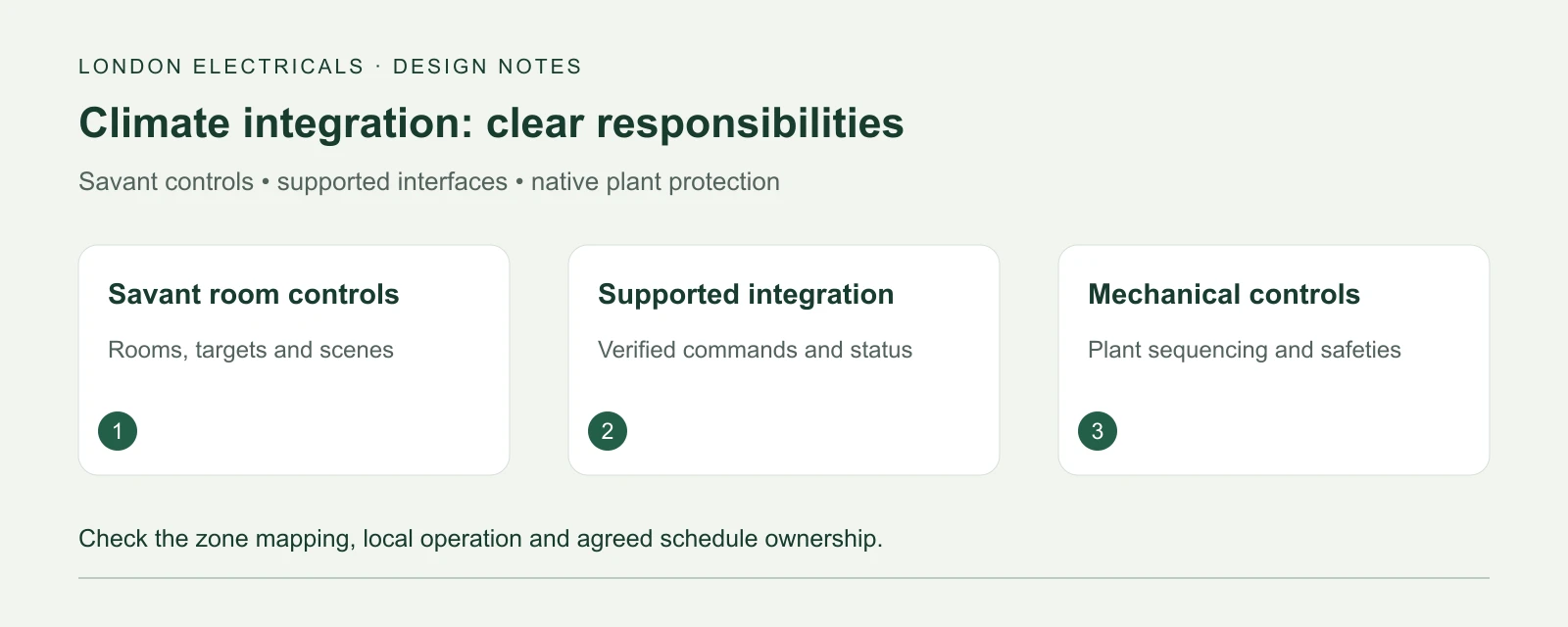
Getting that right starts with the heating and cooling design. Savant is the user-facing control layer, not a substitute for the mechanical engineer's plant controls. Here is what to consider before bringing the two together.
Write down how each space is used. A bedroom, kitchen and home office may need different schedules, and a guest room may spend much of the week unoccupied. Agree clear room names before programming begins. “Principal bedroom” is more helpful than a controller address or a name that only the installer recognises.
Next, establish the actual control zones. One room might have underfloor heating and air conditioning, while several rooms might share a heating zone. A screen can only offer independent control where the installed equipment supports it. Showing three separate room tiles does not create three independently controlled heating circuits.
For a London townhouse, also consider the floors, solar exposure and use of the rooms. These observations inform the brief; they do not replace a heat-loss calculation or a cooling-load assessment. The mechanical designer remains responsible for sizing and the building's thermal performance.
Before promising integration, identify the heating and cooling manufacturers, exact controller models and available interfaces. Record the Savant host and software version as well. The combination matters more than the brand name on its own.
Savant's climate overview describes its climate-control offering, including the Multistat and climate relay modules. That is a starting point, not confirmation that every boiler, heat pump or air-conditioning system will work with every Savant installation. The proposed hardware, integration profile and regional suitability need checking against the actual project.
Ask which functions will be available: measured temperature, target temperature, operating mode, fan settings, schedules and fault information may not all be exposed. A command being available is different from the system returning useful status. Agree the limitations in the proposal so the interface does not suggest a capability the equipment cannot deliver.
The heating and cooling equipment should keep its intended protection and operating logic. Plant safeties, frost protection and any equipment-specific delays belong with the responsible mechanical controls. A whole-home scene must not bypass them.
Where heating and cooling serve the same room, agree how conflicting demands are prevented. The relevant contractor should define the sequence, temperature limits and permitted modes. Savant then presents the agreed choices. This is particularly important when a room has slow-response underfloor heating alongside a faster cooling system.
Local operation deserves attention too. Decide what the wall thermostat does, what Savant does and which system owns the schedule. Two independent schedules changing the same setpoint can make an otherwise sound installation feel unpredictable. One documented arrangement is much easier for the household and the support team to understand.
Useful scenes start with ordinary routines. “Away” might adjust agreed temperature targets in selected zones. A guest-room schedule might prepare the room before a visit. The scope should be explicit: an away scene is not a general instruction to switch off every item of plant.
Discuss response times honestly. A large floor slab does not heat immediately because a scene has been selected. For slower heating, a sensible schedule can be more useful than repeatedly changing the temperature throughout the day. Cooling, shading and lighting can also be considered together, provided each system's role remains clear.
Keep the controls understandable. Most people need room temperature, a simple adjustment and a recognisable mode, not every engineering setting. Advanced settings can stay in the appropriate installer interface. Guests should be able to make a normal adjustment without learning the entire home-control system.
Identify controller locations, power, network connections and any control cabling early. Allow practical access for maintenance, rather than enclosing a gateway behind finished joinery. Coordinate the drawings with the electrical and mechanical contractors so the physical installation matches the integration plan.
In an existing home, first find the available configuration and authorised access. Preserve working settings before changes. Where KNX or a building management system already manages the climate, establish its responsibilities and the supported connection instead of assuming the whole arrangement needs replacing.
Our Savant existing-system takeover service starts with understanding what is installed. That gives improvements a sound basis and helps retain equipment that still serves the home well.
Commissioning should connect a control command to its real effect. Check the room mapping, setpoint changes, returned status and agreed schedule ownership. Test a change from Savant and from the local control. Confirm how the installation behaves after a restart or loss of the relevant connection, with the contractors responsible for those systems.
The handover should include a zone list, the agreed functions, operating limits, configuration records and a clear support route. Seasonal adjustment can be useful, but the household should already understand the normal controls. A tailored maintenance proposal can cover the home-control elements without pretending to replace the heating engineer's servicing responsibilities.
If you are planning a new installation, send the room schedule and available mechanical drawings. For an existing system, photographs of visible controllers and a description of what you want to improve are a useful start. You do not need to open electrical panels or alter installer settings yourself.
Talk to London Electricals about Savant integration. We can help establish the supported connections, coordinate the control design and make the everyday interface simpler. The aim is a home that feels straightforward to use, with each specialist system doing the job it was designed for.
Continue exploring
Services
A Savant home should feel effortless. We assess inherited hosts, remotes, AV and networks, then plan a supported handover around the way you live.
Explore Savant System Takeovers & Home SupportServices
Bring music, cinema, lighting and home control together with Savant. Bespoke design, existing-system takeovers and ongoing care in London.
Explore Savant Installer & Existing-System Support in LondonInsights
Enjoy joined-up lighting, music, television and climate control, with an installation and support plan shaped around your home.
Explore Smart Home Control and Ongoing Care